Report preview

What You Receive From CareerPath4Me

After completing the Wiley-powered assessment, you receive a structured report that combines demonstrated cognitive performance with Behavioral Traits, Interests, career matches, education and training options, and next-step direction.

Report overview

Actionable insight tied to real career options.

The report helps families understand demonstrated cognitive reasoning, Behavioral Traits, Interests, career matches, education and training guidance, and likely work activities.
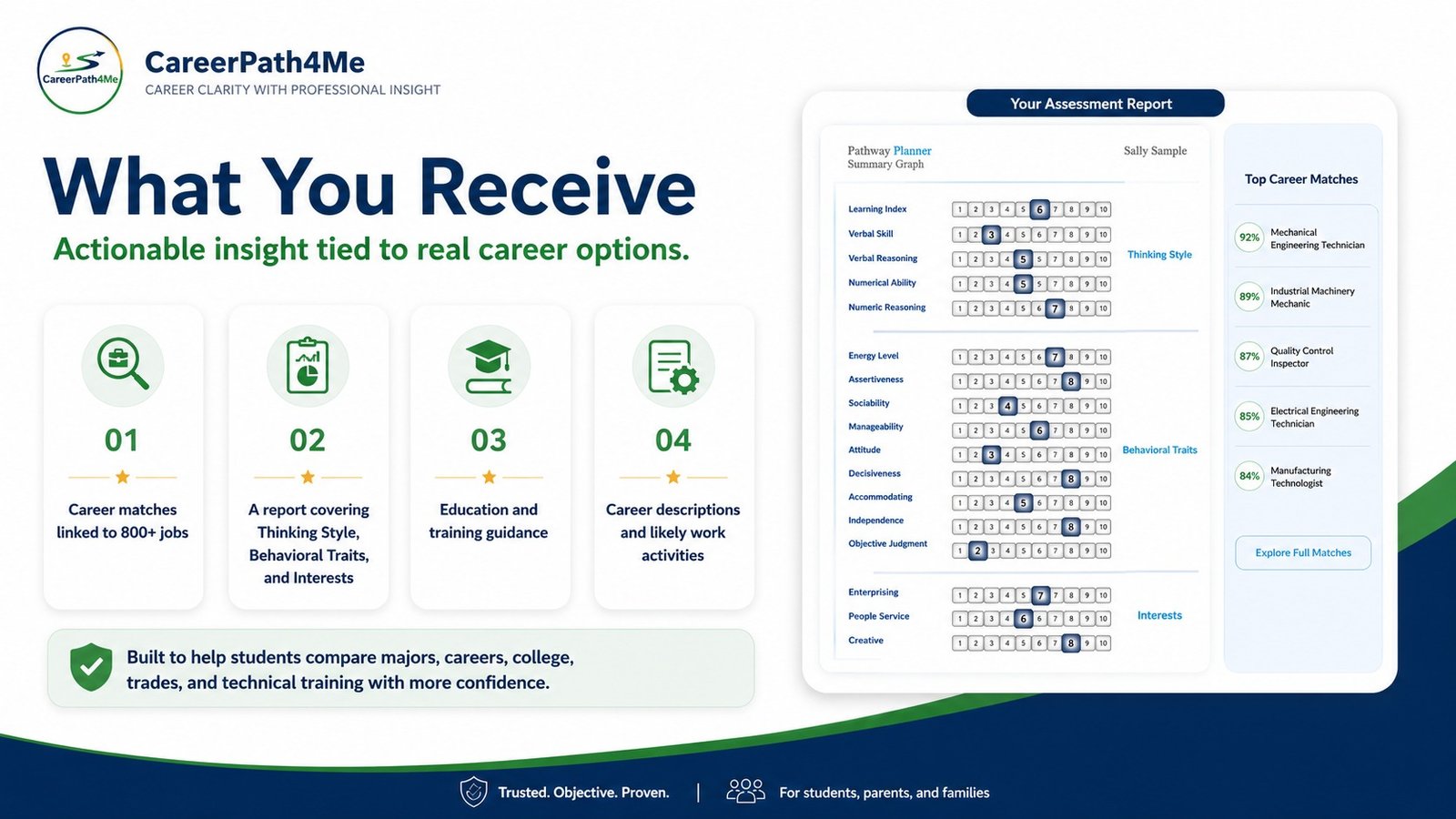
What you receive from CareerPath4Me: career matches linked to 800+ jobs, a report covering Thinking Style, Behavioral Traits, and Interests, education and training guidance, and career descriptions
Inside the report

Your Individual Report

The report gives families a more objective starting point for career conversations by organizing results into practical sections.

01

Cognitive Reasoning (Thinking Style)

Performance on structured verbal and numerical exercises that show how the student learns, reasons, solves problems, and works with information.

02

Behavioral Traits

How the student tends to operate, interact, make decisions, respond to structure, and approach work environments.

03

Interests

The types of work that naturally attract the student, including hands-on, technical, creative, service, administrative, or enterprising work.

04

Career Matches

Potential career path matches tied to selected career clusters, with links to O*NET details such as tasks, skills, education, wages, and related occupations.

Understanding Your Summary Graph

This sample graph shows how individual results are scored across cognitive thinking style, behavioral traits, and interests. The thinking-style scales reflect performance on structured verbal and numerical exercises, while the behavioral and interest scales come from questionnaire responses. We will send you your own Summary Graph once you have completed the assessment. Higher scores often point to natural strengths or stronger preferences. Lower scores usually reflect a different style, not a weakness. Your results are about fit, not right versus wrong. The best use of this report is to compare the complete profile with the career clusters you selected and the career matches provided in the Individual Report.
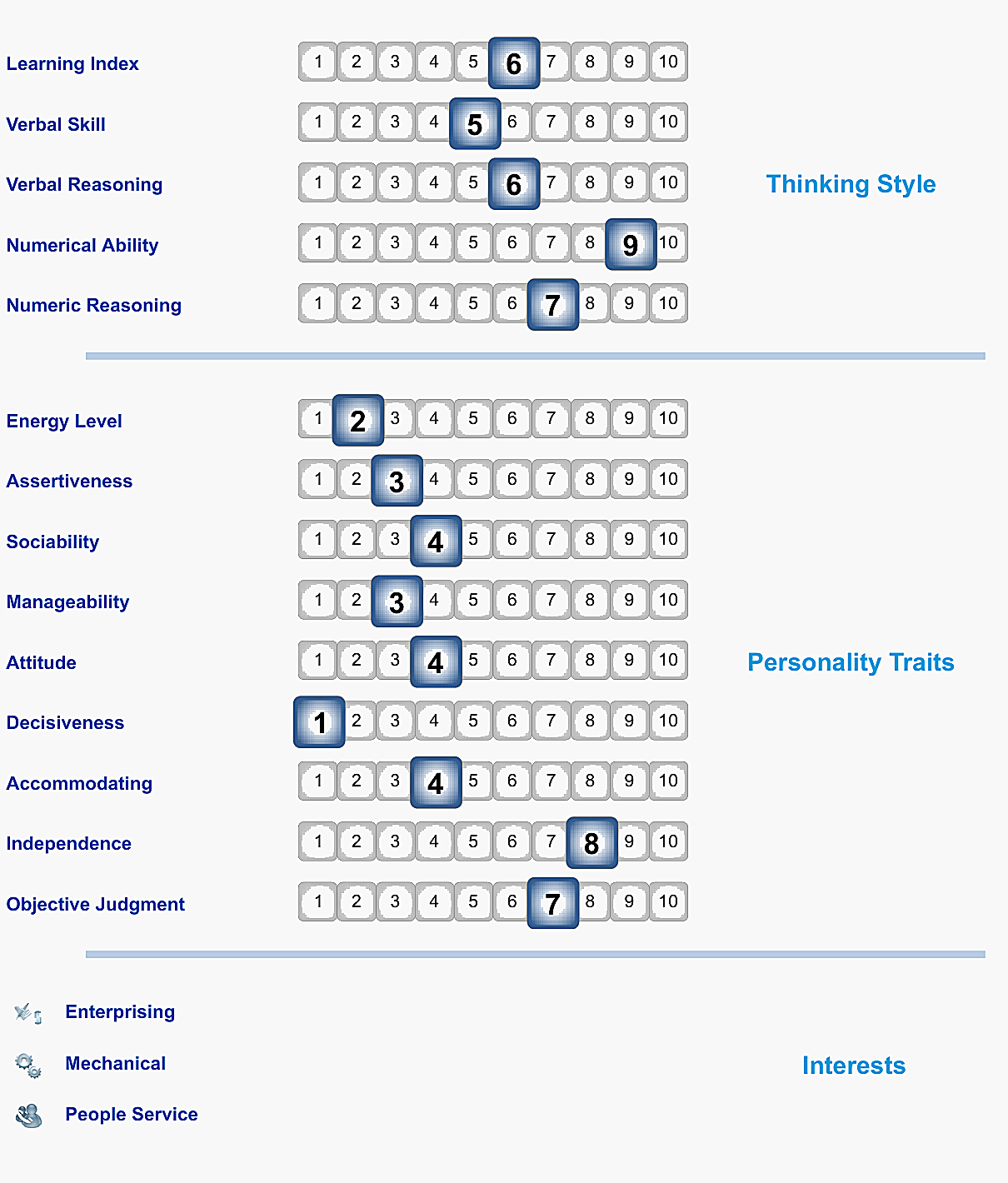
Example shown: this person selected Architecture and Construction, Business Management & Administration and Marketing as the three career clusters they wanted to test against based on the kind of work they believe they will enjoy.
Example CareerPath4Me summary graph showing thinking styles, behavioral traits, and interests

What Each Scale Means

Below are detailed descriptions of the items shown in the summary graph. These help explain what each scale measures and how lower or higher scores may show up in career planning conversations.

Thinking (Cognitive) Scales

Performance-based measures of how you learn, process information, and solve verbal and numerical problems.
Important context: These scales are one part of the overall profile. They are not a clinical IQ diagnosis or a guarantee of success or failure in a particular career.
Scale
What It Measures
Low Score Interpretation
High Score Interpretation
Learning Index
Overall learning, reasoning, and problem-solving ability (composite of verbal + numeric skills)
Prefers concrete, routine tasks; learns best through repetition and job-specific training
Learns quickly; adapts easily; grasps complex ideas and new job requirements
Verbal Skill
Vocabulary and verbal expression
Limited vocabulary; may communicate vaguely or inaccurately
Strong vocabulary; communicates precisely, even under time pressure
Verbal Reasoning
Ability to reason using words and verbal information
May miss inferences; prefers concrete problems
Quickly understands and analyzes verbal information; draws conclusions effectively
Numerical Ability
Comfort and accuracy with calculations
Relies on calculators; may avoid numeric tasks
Performs calculations mentally; confident with numbers
Numeric Reasoning
Ability to analyze and interpret numerical data
Focuses on simple calculations; may miss patterns
Identifies trends; uses data for insights and decision-making

Behavioral Traits

How you operate, interact, and make decisions.
Scale
What It Measures
Low Score Interpretation
High Score Interpretation
Energy Level
Drive, activity level, and pace
Patient, steady, prefers routine work
High energy, self-motivated, multitasker
Assertiveness
Desire to influence and lead
Cooperative, follows others, avoids control
Confident, competitive, leadership-oriented
Sociability
Desire for social interaction and teamwork
Independent, reserved, prefers working alone
Outgoing, people-oriented, enjoys teamwork
Manageability
Attitude toward rules and authority
Questions rules; prefers independence
Follows procedures; comfortable with authority
Attitude
Trust and outlook toward others
Skeptical, critical, cautious
Optimistic, trusting, positive outlook
Decisiveness
Speed and confidence in decision-making
Cautious; needs more information
Makes quick decisions; willing to take risks
Accommodating
Willingness to cooperate and compromise
Direct, may challenge others
Cooperative, harmonious, team-focused
Independence
Need for autonomy vs. direction
Prefers guidance and structure
Self-directed; prefers autonomy
Objective Judgment
Logic vs. intuition in decision-making
Relies on intuition or “gut”
Uses logic, facts, and analysis

Interest Scales

What types of work naturally attract you.
Scale
What It Measures
Low Interest
High Interest
Enterprising
Persuasion, leadership, entrepreneurship
Not drawn to negotiation or influence roles
Enjoys leadership, persuasion, recognition
Financial / Administrative
Organization, processes, and data management
Dislikes structured, detail-oriented work
Enjoys organizing, finance, and procedures
People Service
Helping and supporting others
Less motivated by service roles
Enjoys helping, coaching, and supporting people
Technical
Analytical, scientific, and problem-solving work
Avoids data-heavy or analytical tasks
Enjoys research, data, and complex problem-solving
Mechanical
Hands-on, tools, machinery, physical work
Avoids physical or mechanical work
Enjoys working with tools, machines, outdoors
Creative
Artistic expression and innovation
Less interest in creative work
Enjoys innovation, design, and creative expression